In Malaysian Chinese society, the Hokkien community is one of the largest Chinese dialect groups, and many of its traditional customs have been well preserved. Among these, Malaysian Hokkien funeral customs are especially known for their emphasis on ritual detail, filial piety, and structured ceremonial practices.
For Hokkien families, a funeral is not only a farewell ceremony, but also a continuation of ancestral traditions. Many practices are still observed today, including the “buying water” ritual, paper effigies, and distinctive funeral procession customs. Each step carries cultural meaning and reflects deep respect for the deceased.
1. Cultural Meaning of Malaysian Hokkien Funeral Customs
In Hokkien tradition, honouring the deceased and respecting ancestors are deeply important values. A complete funeral is therefore not only about handling post-death arrangements, but also represents the family’s final act of filial responsibility.
Malaysian Hokkien funeral customs often place strong emphasis on:
- Completeness of rituals
- Funeral procession etiquette
- Family hierarchy arrangements
- Traditional taboos and detailed procedures
Today, many Hokkien families continue to preserve these customs to ensure that the deceased departs in peace, while also praying for blessings, harmony, and protection for the family.
2. The “Buying Water” Ritual: A Key Tradition
One of the most distinctive Hokkien funeral customs is the “buying water” ritual, which may be less familiar to those outside the community.
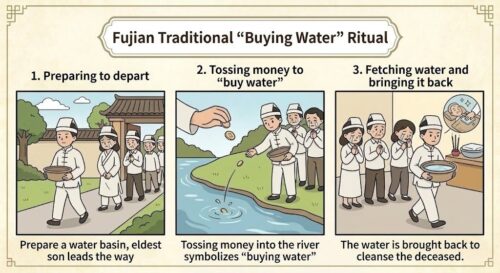
The “buying water” ritual usually takes place shortly after death. Family members prepare a bucket, basin, incense, and other ritual items before proceeding to a designated river, stream, or water source.
In Malaysian Hokkien funeral customs, this ritual is typically led by close descendants, often the eldest son or other direct family members, followed by daughters and other relatives. The family walks in mourning, and upon arrival, coins are thrown into the water as a symbolic act of “purchasing” it. The water is then collected and brought back.
Traditionally, this water is used to cleanse the body of the deceased, symbolising the washing away of worldly suffering so that the departed may leave with dignity. It also represents the family’s final expression of love, care, and respect.
3. Traditional Offerings and Paper Effigies
Hokkien funerals also include distinctive offerings and paper effigy traditions.
Offerings
Common items placed at the altar may include:
- Steamed prosperity cakes, also known as fa gao
- Red tortoise cakes
- Noodles
- Fruits and tea
These offerings carry symbolic meanings. For example, fa gao represents prosperity and growth, while noodles symbolise longevity and continued blessings for the family.
Paper Effigies
In Malaysian Hokkien funeral customs, paper effigies are an important cultural feature. These may include:
- Paper houses
- Paper vehicles
- Daily necessities
- Paper attendants
These items symbolise comfort and provisions for the deceased in the afterlife. They also express filial devotion, remembrance, and the family’s continued care for their loved one.
4. Funeral Procession and the “Return Dragon” Ritual
The Hokkien funeral procession is usually highly structured, with strong attention to hierarchy, order, and etiquette.
Procession Arrangement
Family members are arranged according to generational order. Common practices may include:
Scattering joss paper along the route
The eldest son carrying the portrait of the deceased
Drum, chanting, or ceremonial music accompaniment
The procession is carried out in a solemn and respectful manner, reflecting strong family values and ancestral traditions.
What Is the “Return Dragon” Ritual?
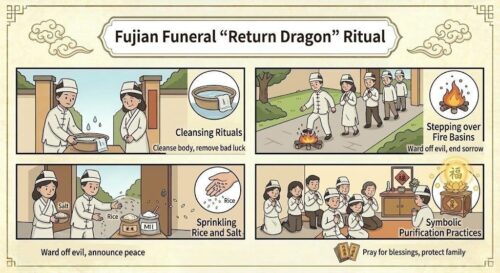
The “Return Dragon” ritual symbolises the family returning home with blessings after the funeral, while ensuring that negative energy is not brought back into the home.
Depending on family tradition, this may include:
- Cleansing rituals
- Stepping over a fire basin
- Sprinkling rice and salt
- Symbolic purification practices
Many Hokkien families in Malaysia still observe these customs today as a way to restore peace, protection, and balance after the funeral.
5. Importance of Dialect-Specific Funeral Expertise
While funeral procedures may appear similar across different Chinese communities, Malaysian Hokkien funeral customs include unique rituals and cultural expectations.
Without proper knowledge, important details may be overlooked, such as ritual sequencing, offering arrangements, family hierarchy, or procession etiquette. This is why experience with culture-specific funeral traditions is essential to ensure that every arrangement is carried out respectfully and correctly.
Preserving Authentic Fujian Funeral Traditions
Hong En Life Bereavement Care provides professional Malaysian Hokkien funeral services, including “buying water” rituals, traditional offerings, paper effigies, and full funeral coordination.
We tailor each arrangement according to the family’s cultural background, beliefs, and preferences, ensuring that every detail is handled with care and respect. Our goal is to help families honour their loved ones with a dignified farewell while preserving meaningful Hokkien funeral traditions.
For Hokkien-specific funeral arrangements, contact Hong En Life at 017-808 2616 for professional consultation and service arrangements.