Condolence money is a traditional monetary gift offered to bereaved families in Malaysia to express sympathy and help ease funeral expenses. In Chinese funeral customs, it is commonly known as pek kim, bai jin or “white gold”.
If you are attending a Chinese funeral for the first time, you may wonder how much condolence money to give, whether RM50 or RM100 is appropriate, and how to prepare the white envelope.
This guide explains the meaning of condolence money in Malaysia, recommended amounts, envelope etiquette and important customs to observe when attending a funeral.
What Is Condolence Money? Understanding Pek Kim and Funeral Money
Condolence money refers to a financial contribution given to the family of someone who has passed away. It is a gesture of sympathy and support, helping the bereaved family manage funeral-related expenses.
In Malaysian Chinese culture, condolence money is known by several names:
| Term | Meaning |
| Condolence money | Financial contribution expressing sympathy |
| Funeral money | General term for money offered during a funeral |
| Pek kim (白金) | Hokkien term meaning “white gold” |
| Bai jin (白金) | Mandarin term for funeral condolence money |
| White packet | Envelope used to present the money |
Unlike red packets exchanged during celebrations, Chinese funeral money is traditionally presented in a plain white envelope to reflect the solemn occasion.
The purpose is not to measure relationships through money, but to offer meaningful support during a difficult period.
How Much Condolence Money Should You Give in Malaysia?
There is no fixed amount for condolence money in Malaysia. The appropriate contribution depends on your relationship with the deceased or their family, your financial circumstances and local customs.
For ordinary friends or colleagues, a modest contribution may be sufficient. Closer relatives and friends generally give more, depending on their circumstances.
The following table provides a general reference for Malaysian Chinese funerals.
| Relationship | Suggested Amount (RM) |
| Colleagues or acquaintances | RM30–RM50 |
| Friends or neighbours | RM50–RM100 |
| Close friends | RM100–RM200 |
| Relatives | RM100–RM300 or more |
| Immediate family members | Depends on family arrangements |
These are suggested amounts based on common practices, not compulsory rates. Actual contributions vary between families and communities.
Is RM50 Enough for Condolence Money?
Yes. RM50 is a reasonable contribution for an acquaintance, colleague or neighbour, particularly when you are not closely related to the deceased.
If you have a closer relationship with the family, you may consider RM100 or more. However, there is no obligation to contribute beyond your financial ability.
Can Colleagues Give Funeral Money Together?
Yes. Group contributions are common in Malaysian workplaces.
For example, several colleagues may contribute towards a shared white packet containing RM200 or RM300. The envelope can include the company name or the names of everyone contributing.
This allows colleagues to express their collective sympathy without placing financial pressure on individuals.
Should Pek Kim Be an Odd or Even Amount?
Traditionally, some Chinese families prefer condolence money amounts ending in odd numbers, as even numbers are commonly associated with happy occasions such as weddings.
For example, some people choose RM51, RM101 or RM151 instead of rounded amounts.
However, Malaysian Chinese customs vary between dialect groups, regions and individual families. RM50 and RM100 are also commonly accepted, and not every family follows the odd-number tradition.
The most important consideration is sincerity rather than the exact number. If you are uncertain about a particular family’s customs, you can ask an older relative or someone familiar with their traditions.
How to Prepare and Write a Condolence Money Envelope
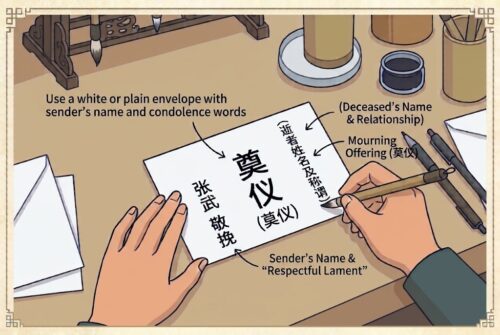
Condolence money is traditionally placed in a white or plain-coloured envelope. Avoid using red packets with celebratory decorations, as red is associated with joyous occasions.
What Should You Write on the White Envelope?
Writing your name clearly is usually sufficient. It helps the family identify contributors and maintain records during the funeral.
You may also include a short respectful message, such as “With Deepest Sympathy” or “In Loving Memory”.
Common examples include:
| Contributor | Suggested Wording |
| Individual | Tan Wei Ming – With Deepest Sympathy |
| Couple | Mr & Mrs Lee – With Heartfelt Condolences |
| Family | The Lim Family – In Loving Memory |
| Company | ABC Sdn Bhd – With Deepest Sympathy |
If the envelope already contains appropriate condolence wording, simply adding your name is generally acceptable.
When and How Should You Give Condolence Money?
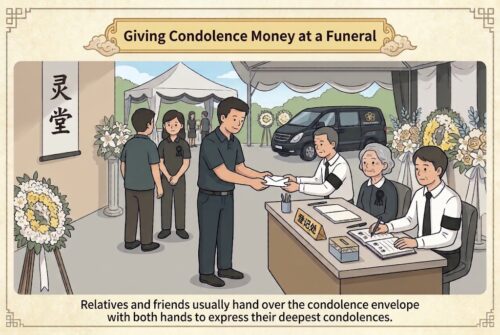
At most Malaysian Chinese funeral wakes, condolence money is collected at a reception counter near the entrance.
Visitors can follow these simple steps:
- Register your name at the reception table, if a condolence book is provided.
- Hand over the white envelope to the person responsible for collecting contributions.
- Pay your respects through bowing, offering incense or observing a moment of silence, depending on your beliefs.
- Offer condolences to the family with a few respectful words.
If you cannot attend, you may ask a trusted friend to deliver your contribution. Some families may also accept bank transfers, although it is better to confirm their preference beforehand.
Chinese Funeral Money Etiquette and Common Taboos
Understanding basic Chinese funeral etiquette helps visitors show respect without unintentionally causing discomfort.
- Avoid Red Envelopes: Red packets are generally reserved for celebrations. Plain white envelopes are more appropriate when offering pek kim.
- Do Not Compare Contribution Amounts: Funeral money should never become a competition. Avoid discussing how much others have given or asking the family about individual contributions.
- Respect Families Who Decline Contributions: Some families explicitly state that they do not accept condolence money. When this happens, respect their wishes and offer support through your presence or a thoughtful message.
- Follow the Family’s Religious Customs: Buddhist, Taoist and Christian families may have different funeral practices. When uncertain, follow the instructions provided by the funeral attendants.
Above all, remember that condolence money is a gesture of compassion, not an obligation.
Is Condolence Money Appropriate for Different Religious Funerals?
Malaysia’s multicultural society has different traditions surrounding funeral donations and expressions of sympathy.
Buddhist and Taoist Funerals
Offering pek kim is common at Malaysian Chinese Buddhist and Taoist funerals. Contributions are usually collected at the wake reception.
Some families may also provide small return gifts according to their traditional customs.
Visitors unfamiliar with religious ceremonies can learn more about Buddhist funeral traditions and Taoist funeral procedures before attending a wake.
Christian and Catholic Funerals
Certain Christian and Catholic families accept condolence money as a gesture of support. Others may prefer flowers, charitable donations or prayers.
It is advisable to check the funeral announcement or ask the family before making arrangements.
Other Etiquette to Remember When Attending a Funeral
Apart from preparing condolence money, visitors should pay attention to appropriate clothing, behaviour and expressions of sympathy.
Choose modest clothing in black, white, grey or other subdued colours unless the family requests otherwise. Avoid overly bright or festive outfits.
When speaking to the family, simple expressions such as “My deepest condolences” or “I’m sorry for your loss” are appropriate. Avoid asking unnecessary questions about the cause of death or discussing sensitive family matters.
If you are unfamiliar with the ceremonies, funeral attendants can guide you through the appropriate customs.
Hong En Life: Supporting Families with Compassionate Funeral Services
Offering condolence money is a meaningful way to express sympathy, but genuine care and support extend beyond financial contributions. Whether you give RM50, RM100 or another amount, what matters most is showing respect for the deceased and compassion towards their loved ones.
At Hong En Life Bereavement Care, we understand the importance of honouring different religious beliefs and cultural traditions. Our team assists Malaysian families with Buddhist, Taoist, Christian and other funeral arrangements, including wakes, cremation, burial and related services.
If your family needs guidance on funeral customs, arrangements or expenses, you can explore Hong En Life funeral services and packages or contact Hong En Life at (017-808 2616) for personalised assistance. We are here to help families arrange dignified and meaningful farewells with understanding, respect and care.